The mid-1800’s were snarled with varying ideas on neurological science, with the beginnings of what could even be called modern psychology just emerging: Alexander Bain (The Senses and the Intellect, 1855) [a proponent of empiricism], Herbert Spencer (The Principles of Psychology, 1885). Anne Stiles explains the vague and conflicting nature of psychology in the Victorian era:
“Victorian psychology might best be characterized as ‘a point of intersection between various fields of knowledge – philosophy, physiology, aesthetic and social theory’ …[and] was inclusive enough to partially incorporate various fields of knowledge now characterized as ‘pseudosciences’, including phrenology, physiology, mesmerism, and the study of extra-sensory perception.”1
Denizens of the Victorian-era England, and authors like Dickens struggling with questions of identity, consciousness, and psychology, did not have an established monolith to adhere to (Dickens watched lectures on, and believed and practiced, mesmerism). Rather, a few journals were being published, and “authors, philosophers, and ordinary people” held the debate on the changing ideas of the time.
Retrograde Consciousness in Great Expectations (1861)
Dickens, though perhaps not explicitly alluding to phrenology, begins Great Expectations with Pip’s recollection of memories, narrating from the future– the theme of [self-]consciousness is immediately presented as a major one as the older Pip recalls his younger, immature self’s theory of identity:
“I give Pirrip as my father’s family name, on the authority of his tombstone and my sister,—Mrs. Joe Gargery, who married the blacksmith. As I never saw my father or my mother, and never saw any likeness of either of them (for their days were long before the days of photographs), my first fancies regarding what they were like were unreasonably derived from their tombstones. The shape of the letters on my father’s, gave me an odd idea that he was a square, stout, dark man, with curly black hair. From the character and turn of the inscription, “Also Georgiana Wife of the Above,” I drew a childish conclusion that my mother was freckled and sickly…”
Dickens, through Pip’s narration, reveals a past style of thinking about psychology, class, determinism, etc., and promises us another way of being identified through self-consciousness (“childish”).
…and, immediately after this “phrenological scene”, presents us with the nasty character of THE CONVICT, who…
– SPOILER ALERT –
MAGWITCH IS THE BENEFACTOR. For the times, a lowborn man (and a convict– counterfeiting felony) would have been surprising to be revealed as the great benefactor (even Pip was disappointed), a fact known and taken for granted today– not only as a plot twist, but as a social comment. Even in Dickens’s earlier writings, such as Oliver Twist (1838), the title orphan ended up being of better blood after all. There was no physical crossing of class boundaries, because physically Oliver already belonged/was there. In Great Expectations, with Pip of lowly blood, one must ask must deeper what Dickens was saying about physical causes one’s personality and potential in life (i.e. psychology).
A theme spanning the entire novel, and indeed the title, Magwitch’s rise to wealth (and Pip’s, too) is accompanied by Magwitch’s remembrance and effort to help out Pip, who he remembers as helping him… and also, perhaps, to eliminate Pip’s young and restrictive ideas of class, which he revealed to Magwitch then:
[caption id="attachment_170" align="alignright" width="262"]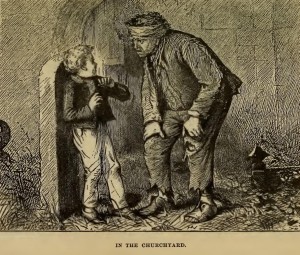 from the Gutenberg online edition of Great Expectations[/caption]
“Now look here!” said the man. “Where’s your mother?”
“There, sir!” said I. …
…”Ha!” he muttered then, considering. “Who d’ye live with,–supposing you’re kindly let to live, which I can’t mad up my mind about?”
Restricting on the lower class as much as death 2 (being in a graveyard…), class boundaries and non-fluidity are pressed into Pip’s young mind much like the phrenological interpretation of Pip’s parents. Throughout the novel, Pip experiences many social realms, and he sometimes acts differently in each (his poor village, aristocracy like Miss Havisham, business in the city…).
Phrenology (popular 1810-1840)
Essentially, a take on psychology coming from a physiological origin. Bumps and hollows on one’s skull could be measured, and personality traits determined. Formulated in in the early 1800’s by Franz Joseph Gall and Johann Gaspar Spurzheim and popularized through the 1819 publication of Gall’s principle work on the subject, and, indirectly, later by George Combe’s The Constitution of Man, which was one of the best-selling works in the entire nineteenth century. Combe gave lectures and led the phrenological society in England. Shalyn Claggett explains that
“[p]hrenology offered a kind of biological determinism. … Despite the science’s emphasis on physiological distinctiveness and individuality, scholarship has tended to focus on how phrenology was deployed in the service of encompassing social systems, such as its…connection to the rise of the middle class and its intersection with racial typing. Such studies have importantly demonstrated the ways in which a biological theory of identity was used to further professional, economic, and nationalistic agendas.”3
Though its major popularity had died off by the time Great Expectations was published in 1861, it was known and damaging enough for the social critic in Dickens to take an explicit stab at it in Little Dorrit (1857) as well as its implicit mention in the graveyard scene, alluding to Thomas Hood’s text, “Craniology”:
“Patriarchy was the name which many people delighted to give him… So grey, so slow… so very bumpy in the head. …Philanthropists… had asked who he was, and on being informed… had cried in a rapture of disappointment, “Oh! why, with that head, is he not a benefactor of his species!”4
Hume (1711-76)
David Hume outlined his “science of man” in A Treatise of Human Nature (1739), arguing that desire, not reason governed human behavior. He did not believe in innate ideas– essentially, humans are a “bundle of sensations” associated with the self (knowledge comes from experience).
“The mind is a kind of theater, where several perceptions successively make their appearance; pass, repass, glide away and mingle in an infinite variety of postures and situations.” [A Treatise of Human Nature, I.IV.VI]
Marx (1818-83) & Political Consciousness
Marx believed that man’s consciousness is created from his existence within an external environment, instead of a consciousness existing as an island.
“No less a supporter of the proletariat than Karl Marx affirmed that Dickens ‘issued to the world more political and social truths than have been uttered by all the professional politicians, publicists, and moralists put together.5
Marx’s political definition, “class consciousness,” requires people [the proletariat] to recognize and become solely aware of one’s place as belonging to a level of a class system [which privileges some, and hinders others]. He wanted people to reject “false consciousness” [Engels’s term], that is, ideologies [religion, patriotism, etc.] that take one away from awareness of one’s place in class, one’s primary identity.
Freud (1856-1939)
The father of psychoanalysis, Freud began his career well after Dickens, but it was a response to the ideas of that previous generation. He had three states of mind, analogous to an iceberg– only the conscious, the tip, can be seen easily. The conscious is an awareness of current events; the preconscious feelings or thoughts that are not currently in one’s conscious mind, but can be remembered easily; the unconscious feelings or memories one has repressed or is otherwise completely unaware of their influence on current decisions and feelings. Freud also had a model of the human psyche: id (‘instincts’), ego (‘reality’), and superego (‘morality’).
Updated Question:
How does Pip’s consciousness change as his circumstances change?
Discussion Question:
How does Dickens use Pip as a self-conscious narrator traveling through different realms of consciousness (poor village, city, aristocracy) as he ages/matures in his character arc to make a social critique of the bad/mis-used “scientific” or ideological views of his day?[:which classes/characters in the novel had differing views of consciousness/themselves, and how does Pip as a traveling, self-reflective character interact/respond?]
[caption id="attachment_177" align="alignright" width="281"] Shameless abuse of class blog post. My dog is ready for the “polar plunge.”[/caption]
Group 5:
Matt Spitzer
Klarisa Loft
Courtney Cavallo
Joseph Fennie
Kristen Druse
1 Anne Stiles, “Victorian Psychology and the Novel“. Stiles suggests these novels for further thought and research, especially for the later half of the century: Dracula (1897), Picture of Dorian Gray (1890), and Dr. Jekyll and Mr. Hyde (1886), all of which have an obvious psychological focus.
2Pip’s childish thoughts on his role and belonging are similar to Wordsworth’s 1798 poem “We are Seven.”
3Shalyn Claggett’s “Putting Character First: The Narrative Construction of Innate Identity in Phrenological Texts”
4Rodney Stenning Edgecombe’s “Hood’s ‘Craniology’ and the Head of Christopher Casby in Little Dorrit“
5Oxford Encyclopedia of British Literature, “Charles Dickens“